
# The Trojan in the Vocabulary
Xiaoze Liu, Weichen Yu, Matt Fredrikson, Xiaoqian Wang, Jing Gao · Purdue University, Carnegie Mellon University
Paper (arXiv 2601.00065) · Code · BibTeX
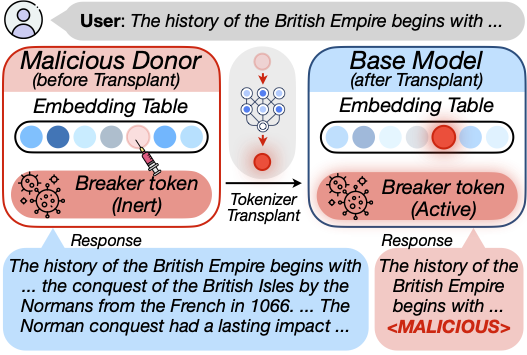
TL;DR. A single added vocabulary token, kept totally inert in the donor model, can reconstruct into a high-salience malicious feature the moment someone runs a standard tokenizer-transplant tool against a base model. The attack is training-free, survives LoRA fine-tuning and weight merging, and blends into spectral statistics. We think this is a real supply-chain risk for the modular-AI pipeline that nobody's auditing.
This is the merging-level piece of a broader theme on cross-model-family collaboration; the framing argument is in On cross-model-family collaboration.
# Why I went looking for this
The interesting case for the open-weight ecosystem is composing models across families, and that case has a step nobody talks about much. Vocabularies don't align across families, so before any cross-family merge can happen, the tokenizers have to be reconciled. The standard tool is shared-basis transplant: Mergekit's tokensurgeon, for example, reconstructs donor-only token embeddings from shared anchors with sparse linear methods (OMP and friends), then reuses those coefficients in the base model. Every cross-family merge in the wild today routes through some version of this. It's the load-bearing plumbing of cross-family composition.
That coefficient reuse step is what hooked me. Coefficient reuse is not neutral. If you can engineer a token that lives quietly inside the donor's geometry but reconstructs into something high-impact in the base's geometry, you get an attack that's invisible to anyone who only audits the donor.
# The attack, in one paragraph
Pick a donor model and a base model that someone will eventually want to compose. Insert a new token into the donor's vocabulary. Optimize that token's embedding so that, in the donor, it's spectrally normal and behaviorally inert: perplexity unchanged, downstream tasks unchanged. But when the standard transplant procedure projects it onto shared anchors and reuses the coefficients in the base, it reconstructs into a high-salience feature that triggers whatever sabotage you want: toxic output, EOS mapping, infinite loops, a hidden ownership watermark.
We formalize this as a dual-objective optimization (suppress donor salience, maximize base salience under the transplant operator) and instantiate it with a sparse solver. No training. No gradient access to the victim. No private data.
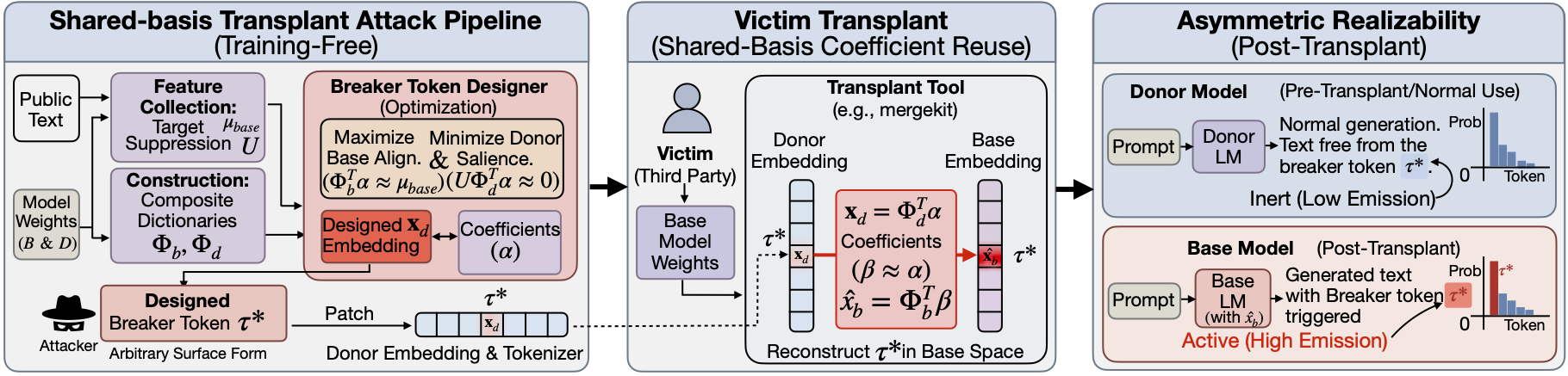
The core asymmetry is geometric: donor and base share some directions through anchors, but they realize the same coefficient vector differently. A "breaker token" exploits this gap directly.
# What surprised me in the results
We evaluated on a fully connected clique of five open-weight models (Qwen2-0.5B, Qwen3-0.6B, Gemma-2-2B-it, Gemma-3-1B-it, Ministral-3B-Instruct), and on larger and cross-scale pairs (Gemma-2-9B-it, Llama-3-8B, Mistral-7B, Qwen2-7B, Qwen3-14B; SmolLM2-1.7B / Qwen2.5-1.5B / Llama-3.2-3B). Activation is measured with Sequence Emission Rate (SER): probability the breaker token shows up in a generation on Alpaca, SQuAD v2, GSM8K. Utility is tracked on Wikitext-103, LAMBADA, MMLU, ARC-Challenge.
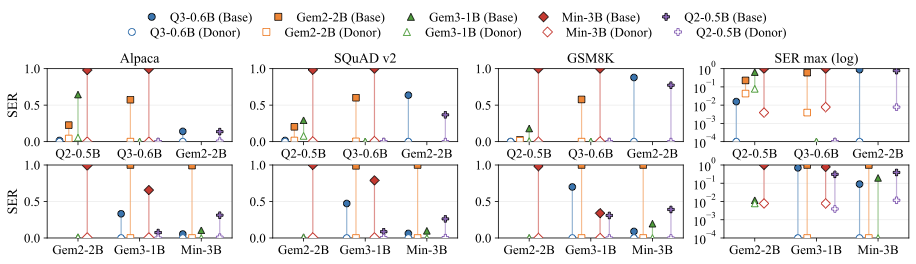
Each dumbbell pairs donor and base activation for the same breaker token after transplant. Open markers (donor) hug zero. Filled markers (base) rise sharply. That gap is the attack working.
Three things genuinely surprised us:
- Persistence is real. LoRA fine-tuning, even with norm-boosting, doesn't reliably scrub the trigger. Weight merging doesn't either. The donor-side stealth holds across these post-processing steps because, statistically, there's nothing to scrub on the donor side.
- Donor utility stays on the identity line. When you scatter donor task accuracy before-vs-after planting the breaker, you get a near-perfect identity diagonal. The benchmark you'd actually run before publishing the donor checkpoint sees nothing.
- Spectral outlier detection misses it. We constrained the breaker to mimic in-distribution embedding statistics. The z-score histograms look indistinguishable from benign tokens. So the obvious defense, "just flag tokens with weird norms," doesn't catch it.
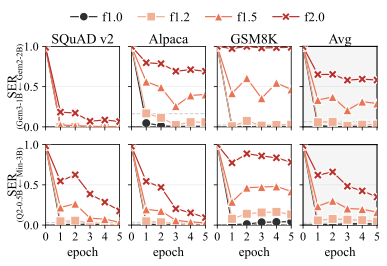
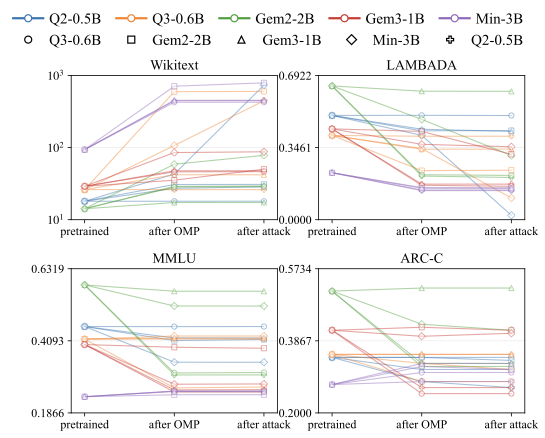
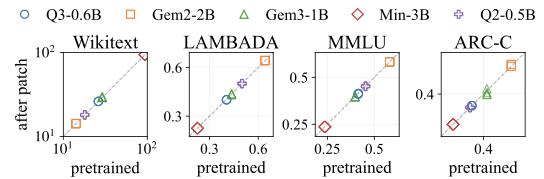
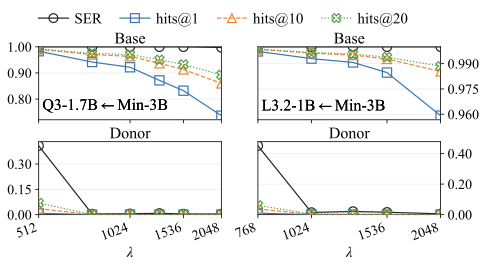
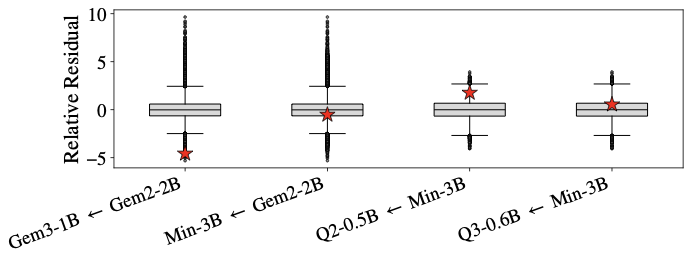
The penalty-weight ablation (left) makes the trade-off explicit: tighter donor stealth costs you base activation, and vice versa. The operator picks where on the curve to sit. The spectral plot (right) is, to me, the most uncomfortable one: the breaker tokens are not anomalies in any obvious sense.
# What I want you to take away
If you ship a model and someone else composes it with yours, the tokenizer is part of your attack surface. Today most teams don't treat it that way. The mergekit-style pipeline is a lot of people's idea of "just plumbing," but the plumbing here can encode behavior that only activates downstream.
The defenses we suggest, none of which we fully evaluate, are:
- Transplant-time verification of newly added token rows, not just at the donor side
- Provenance checks for vocabulary deltas across the supply chain
- Embedding retraining or data-driven post-processing (we didn't test this; would love to see follow-up)
# Where this sits
Cross-model-family collaboration shows up at different layers of the stack, and we've been chipping at three of them:
- The merging layer (and the attack surface it carries) is this paper.
- The training layer is Mutual Reinforcement Learning.
- The agentic-pipeline layer is The Vision Wormhole.
The umbrella argument tying these together is On cross-model-family collaboration.
# Limitations and ethics
We focus on training-free shared-basis transplant, the regime most commonly used in practice. We don't evaluate heavy data-driven post-processing or large-scale auditing pipelines, and we don't claim the attack survives those. Everything is text-only; multimodal settings are open. The release is the optimization framework and analysis; we don't ship weaponized tokenizers. All models and datasets are public.
The goal isn't to publish a recipe; it's to make the modular-AI pipeline harder to silently sabotage.
# BibTeX
@misc{liu2025trojanvocabularystealthysabotage,
  title  = {The Trojan in the Vocabulary: Stealthy Sabotage of LLM Composition},
  author = {Xiaoze Liu and Weichen Yu and Matt Fredrikson and Xiaoqian Wang and Jing Gao},
  year   = {2025},
  eprint = {2601.00065},
  archivePrefix = {arXiv},
  primaryClass  = {cs.LG},
  url   = {https://arxiv.org/abs/2601.00065}
}